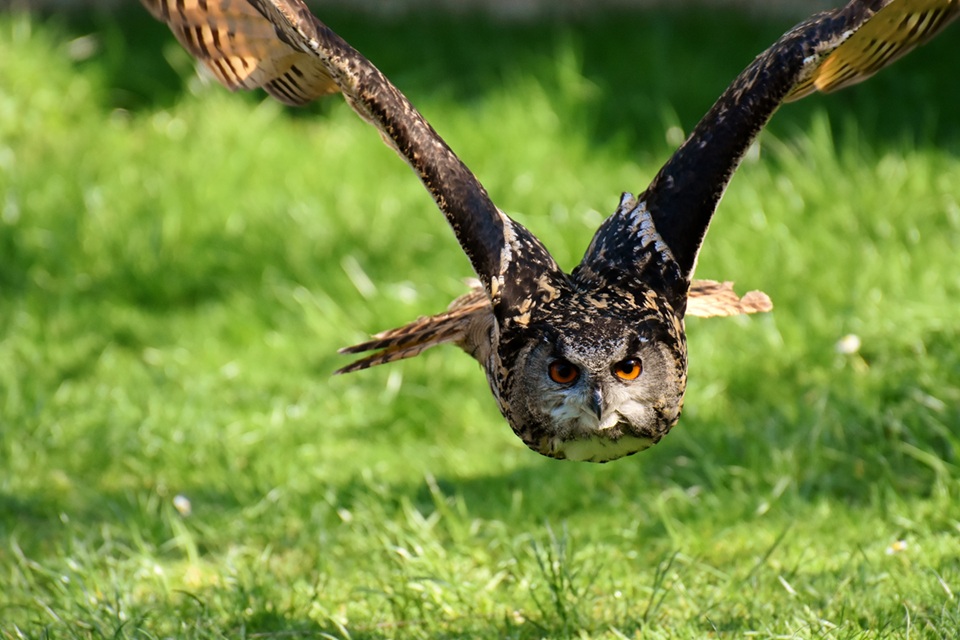
As the sun sets and darkness falls, a ghostly silhouette takes flight—its wings beating silently as it glides through the forest. This is an owl, a master of nocturnal hunting with a set of adaptations that make it one of the most efficient predators in the animal kingdom. From its keen eyesight to its silent flight, every part of the owl is designed for hunting in the dark.
Owls have extraordinary eyesight. Their eyes are large and forward-facing, giving them binocular vision that allows them to judge distance with precision—critical for catching prey in the dark. Unlike humans, owls can’t move their eyes in their sockets, but they can rotate their heads up to 270 degrees, giving them a nearly 360-degree view of their surroundings. Their eyes also have a high density of rod cells, which are sensitive to low light, allowing them to see clearly even on moonless nights.
But perhaps the owl’s most impressive adaptation is its silent flight. The edges of their wing feathers are soft and fringed, which breaks up the airflow and reduces noise. This allows them to sneak up on prey—like mice, voles, and insects—without being heard. Owls also have excellent hearing: their facial discs (the flat, circular feathers around their eyes) act like satellite dishes, directing sound to their ears. Some owl species have asymmetrical ear openings, which helps them pinpoint the exact location of prey using sound alone.
Owls come in all shapes and sizes, from the tiny elf owl (just 13 centimeters tall) to the large Eurasian eagle-owl (over 70 centimeters tall). They are found on every continent except Antarctica, and their haunting calls are a familiar sound in forests, deserts, and even urban areas. These silent hunters play an important role in controlling rodent populations, making them valuable members of ecosystems worldwide.