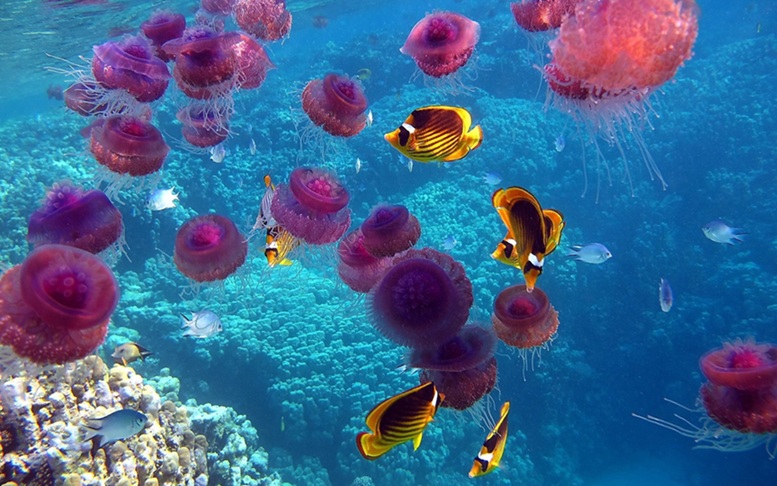
Drifting silently through every ocean on Earth, from sunlit shallow waters to the pitch-black abyssal depths, jellyfish are some of the planet’s oldest and most mysterious creatures. These gelatinous invertebrates have roamed the seas for over 500 million years—predating dinosaurs by more than 200 million years—and their simple yet effective body design has allowed them to survive countless mass extinctions.
Despite their delicate, translucent appearance, jellyfish have no brain, heart, or bones. Their bodies are made up of 95% water, with a thin outer layer called the epidermis and an inner layer that digests food. Sandwiched between these layers is a jelly-like substance called mesoglea, which gives them their squishy texture. Instead of a brain, they have a nerve net that detects light, touch, and chemicals in the water, helping them navigate and find prey like small fish, plankton, and crustaceans.
Jellyfish use their stinging tentacles to capture food and defend themselves. Each tentacle is lined with tiny, harpoon-like cells called nematocysts. When something brushes against the tentacle, these cells fire a venomous barb that paralyzes prey. While most jellyfish stings are just painful to humans, a few species—like the box jellyfish—have venom powerful enough to be fatal.
One of the most fascinating things about jellyfish is their ability to regenerate and, in some cases, reverse their life cycle. The immortal jellyfish, for example, can transform its adult body back into a juvenile polyp when faced with stress, injury, or starvation. This process allows it to essentially reset its life and grow into a mature jellyfish again—making it theoretically immortal.
Jellyfish play a crucial role in marine ecosystems. They are a food source for sea turtles, birds, and some fish species, and their massive blooms can even help regulate ocean temperatures by absorbing sunlight. However, climate change, pollution, and overfishing have led to an increase in jellyfish populations in some areas, disrupting local ecosystems and even clogging fishing nets and power plant intake pipes.
These ancient drifters are a reminder of how resilient life can be, even in the face of extreme environmental changes. Their simple yet effective design has stood the test of time, making them one of the ocean’s most enduring and intriguing inhabitants.