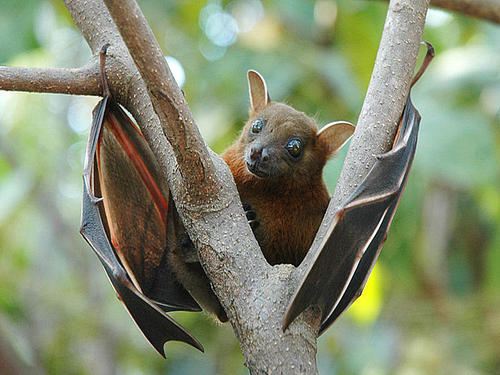
The maned sharp-toothed flying fox is an animal in the family Pteropusidae and the genus Sharp-toothed Flying Fox. The head and body are 178-290 mm long; there is no tail. The forearm length is 125-203 mm, and the wingspan is 1.51-1.7 meters. Weighing 1050-1200 grams, it is one of the largest bats in the world. Males are larger and heavier than females. The forehead and sides of the head of this species are dark brown or black, the shoulders are reddish brown, and the lower back and sides of the body are dark brown or black. The nape ranges from cream to golden. There is a thin orange line on the back of the neck. Yellow hair is scattered in varying degrees throughout the coat, especially on the lower body. Color changes are independent of age, gender, or region of growth.
Their habitat is usually on small offshore islands. Typically found in hardwood trees on steep valleys, cliff edges, or inaccessible slopes. Other preferred habitats include bamboo thickets, mangroves, and other swamp forest areas.
When foraging, the species shows a strong preference for undisturbed habitats of primary forest or high-quality secondary forest, and will travel long distances from its habitat to reach these locations. Also like river edges because of the special plant communities. They are rarely seen foraging in disturbed or agricultural areas, but they frequently cross between forested areas.
They can fly up to 40 kilometers in search of food, mainly eating a variety of fruits, especially figs. Because they specialize in eating fruits, they can help spread seeds and contribute greatly to the replantation of forests. It is a species endemic to the Philippines, and the Philippine government is planning to conserve the maned sharp-toothed flying fox from the threat of extinction. Their numbers once exceeded a thousand, but have been greatly reduced due to habitat loss and hunting.